The first bond ever calculated
Two hydrogen atoms, one equation, and a binding energy that came out right in kind and two thirds right in magnitude. Heitler and London showed that quantum mechanics produces chemical bonds — and, in the same stroke, that calculating one accurately was going to take another forty years.
- Say why two neutral hydrogen atoms have no classical reason to attract each other
- Explain what the exchange term is, and why it supplies most of the binding
- State what Heitler and London got, what the molecule actually does, and how large the gap is
- Read Dirac’s 1929 remark for what it says rather than for what it is usually quoted as saying
Take stock of where the last two lessons leave a bond, as of 1926. Lewis has a shared pair of electrons. It organises the formulae of the whole of chemistry, it forbids the compounds that do not exist, and it explains nothing — the pair is a rule read off the evidence, and the cube drawn to illustrate it could not even accommodate nitrogen. Kossel has ions attracting each other. That at least has a mechanism: opposite charges attract, the arithmetic works to a few per cent, and nobody needs a new physics to believe it. The shared pair has no such excuse, and the problem is worth stating starkly. Two hydrogen atoms are electrically neutral. Neither has a dipole moment. Bring them together and, on any classical account, the attractions and the repulsions cancel out to nothing at all: the electrons repel each other, the nuclei repel each other, and each electron is attracted to both nuclei. There is a small residual — the van der Waals attraction — worth a few thousandths of an electronvolt. The H₂ molecule is bound by 4.75 eV. That is a thousand times larger, from two of the simplest objects in the universe, and classical physics has nothing whatsoever to say about where it comes from.
Zurich, the summer of 1927. Erwin Schrödinger had published his wave equation eighteen months earlier and had two young men working in his orbit. Walter Heitler was 23, on a Rockefeller fellowship. Fritz London was 27. Neither was a chemist; both had been working on the much subtler problem of the weak forces between atoms that do not bond, which is what London would return to and solve two years later. What they did instead was write down the simplest molecule there is — two protons, two electrons — and ask the equation what happened when the protons were brought together. The paper was received by Zeitschrift für Physik on 30 June 1927. It is called, in translation, "Interaction of neutral atoms and homopolar binding according to quantum mechanics", and the word homopolar is doing real work in that title: it means the bond between like atoms, the one that is not ions attracting, the one nobody could account for.
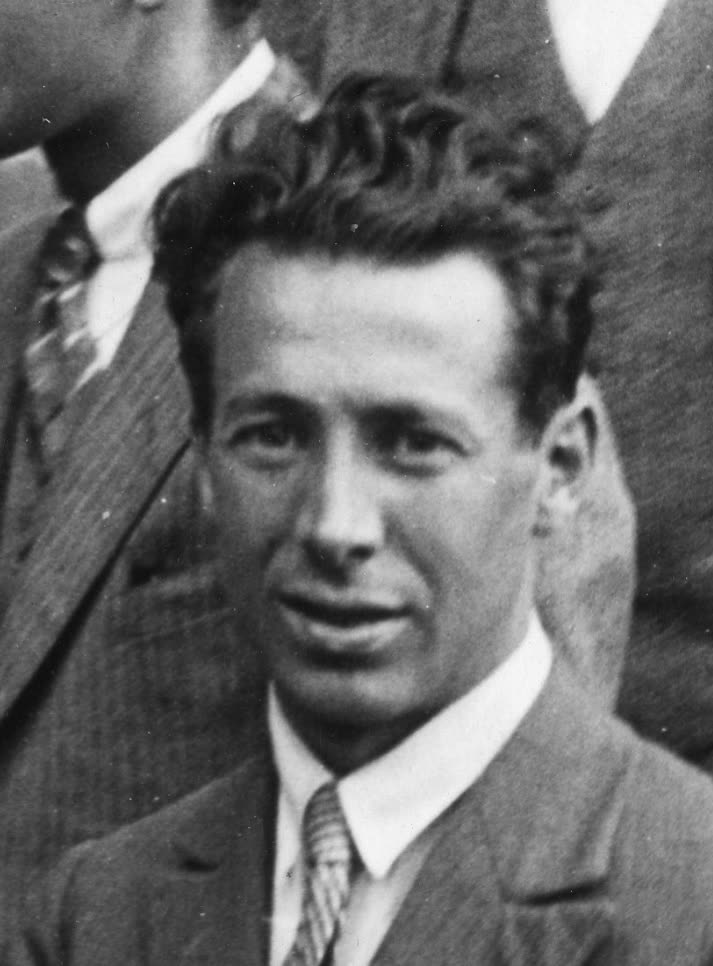
Fot. Comm. A. Petitti, Roma, courtesy of AIP Emilio Segrè Visual Archives, Goudsmit Collection, 1931. Attribution
Interaction of neutral atoms and homopolar binding according to quantum mechanics
- The question
- Two neutral hydrogen atoms have no classical reason to attract each other, and they bind by nearly five electronvolts. Does the Schrödinger equation, applied honestly and with nothing put in by hand, produce a chemical bond?
- The apparatus
- Pencil and paper. The trial wavefunction is a 1s orbital on each nucleus, with electron 1 on the left and electron 2 on the right, PLUS the same arrangement with the two electrons swapped — because the electrons are indistinguishable and there is no fact of the matter about which is which. No adjustable parameters at all: the orbital exponent is fixed at the free-atom value. The energy then requires five two-centre integrals, one of which needs an exponential integral, and all five have closed forms.
Nothing in particular. There was no reason to expect a bound state and no reason to expect an unbound one, and there had never been a calculation of a molecule to compare against. This is a rare case of an experiment run without a prediction.
A minimum, of depth 3.16 eV at 0.869 Å — against the molecule's 4.75 eV at 0.741 Å. And, from the same calculation, a second state with the electron spins parallel that has no minimum at any separation whatsoever: purely repulsive.
How sure could they be? Heitler and London's own paper approximated the hardest of the integrals. Sugiura evaluated all five exactly later the same year and obtained the figures usually quoted — about 3.15 eV at 1.64 bohr. That exact version is what this lesson's simulation computes, live, so the number in the prose is the number in the picture. The measured values, from spectroscopy, are 4.7466 eV and 0.74144 Å, and are known far better than the calculation.
Quantum mechanics produces chemical bonds. Not as an analogy, not as a reinterpretation — you write down the equation, you turn the handle, and a well appears in roughly the right place with roughly the right depth. And the fact that the parallel-spin state is repulsive means that the same calculation explains why the electrons in a bond come in pairs with opposed spins, which is the thing Lewis had asserted eleven years earlier and could not justify.
The dashed curve is the 1927 calculation; the solid one is the molecule. Drag along both and watch the gap. Then look at how the readout splits the calculated energy between its classical and its exchange parts.
And now the result that should have made chemists sit up, which is not the number at all. The same calculation produces two answers, because there are two ways to combine the two arrangements. Add them, and the spatial wavefunction is symmetric under swapping the electrons. Electrons are fermions, so the total wavefunction must be antisymmetric, which forces the spin part to be antisymmetric too — the singlet, one spin up and one spin down. This is the state with the well in it. Subtract them, and the spatial part is antisymmetric, so the spins must be parallel — the triplet. This state has no minimum at any separation. It is repulsive everywhere. Two hydrogen atoms approaching with parallel spins simply bounce. Stop and look at what has just happened. Lewis said in 1916 that a bond is a pair of electrons. Not one, not three — two. He had no reason; it was read off the formulae. Here the pair falls out. The bonding state requires opposed spins, and the exclusion principle permits exactly two electrons with opposed spins in one spatial arrangement. The bond holds two electrons because the Pauli principle allows two. A third has nowhere to go. Eleven years after Lewis asserted the pair, the pair is a consequence.
Now be honest about the error, because the popular telling of this story tends not to be. 34 per cent of the binding energy is missing, on the simplest molecule that exists. The bond length is 17 per cent too long. There is nothing to adjust, because there was nothing put in — which is admirable, and also means there is no way to make it better without changing the method. Put the question the way a working chemist would have put it in 1928. Can this new physics tell me the strength of a bond I care about? The answer was no. It would remain no for decades. A third of the way out on H₂ is a third of the way out, and a bond energy that is a third wrong is not usable for anything — you cannot predict which of two reactions runs, or what a molecule will do when heated, on numbers like that. So hold both statements at once, because both are true and they point in opposite directions: As a demonstration that quantum mechanics produces chemical bonds, it was overwhelming and immediate. As a method of calculating one, it was useless. Almost everything interesting about the next half-century of chemistry lives in the space between those two sentences.
The first bond, in the units chemists use
Chemists do not work in electronvolts. Convert the Heitler–London well depth into kilojoules per mole, and compare it with the tabulated bond dissociation enthalpy of H₂, which is 436 kJ/mol.
- Heitler–London well depth
- 3.156 eV
- Conversion
- 1 eV per particle = 96.485 kJ/mol
- Measured well depth, H₂
- Dₑ = 4.747 eV
- Measured, from the lowest vibrational level
- D₀ = 4.478 eV
After 1927, chemistry was reduced to physics.
Dirac’s famous sentence is usually quoted as a physicist annexing chemistry, and it contains its own refutation in the second clause: the equations are "much too complicated to be soluble". Both halves were correct, and the second half held for sixty years. Getting H₂ — two electrons — right took until 1933 and a thirteen-term wavefunction that is not a picture of anything. Benzene has 42 electrons. Useful, predictive quantum chemistry did not arrive with Heitler and London, or with Pauling, or with the first computers; it arrived in the 1990s, on the back of density functional theory, which sidesteps the wavefunction altogether and for which Walter Kohn and John Pople shared the 1998 Nobel Prize in Chemistry. And it still cannot be run on a protein without approximations that a physicist would call heroic. "In principle" was and is carrying an enormous amount of weight in that sentence.
The repair took decades, and every step of it cost something. 1928, Shou Chin Wang. Let the atomic orbitals contract slightly — one adjustable number, the effective nuclear charge, raised from 1 to 1.166 — and the binding improves to about 3.78 eV. One parameter, and half the remaining error goes. It also means the calculation is no longer parameter-free. 1933, Hubert James and Albert Coolidge. Thirteen terms, in a coordinate system built around the two nuclei, including the distance between the two electrons explicitly so that they can avoid each other properly. The answer comes out within about 0.05 eV of the measurement. Essentially right. And look at what had to be given up. Their wavefunction is not two atoms sharing a pair. It is not a picture of anything at all — it is thirteen coefficients fitted by minimising an energy. Accuracy and interpretability came apart in 1933 and they have never really come back together, which is the central tension of computational chemistry to this day. 1960s, Włodzimierz Kołos and Lutosław Wolniewicz. With a hundred terms and a computer, they computed the dissociation energy to a precision better than anyone had measured it.
The underlying physical laws necessary for the mathematical theory of a large part of physics and the whole of chemistry are thus completely known, and the difficulty is only that the exact application of these laws leads to equations much too complicated to be soluble.
- 1916Lewis asserts that a bond is a pair of electrons, and cannot say why it is a pair.
- 1926Schrödinger publishes the wave equation. Heisenberg introduces exchange, to explain helium.
- 1927Heitler and London compute H₂ in Zurich; Sugiura evaluates the integrals exactly. 3.15 eV against a real 4.75.
- 1928Wang adds one adjustable parameter and reaches 3.78 eV.
- 1929Dirac: the laws are known, and the equations are too complicated to solve.
- 1931Pauling turns the method into valence bond theory, and chemistry gets hybridisation and resonance.
- 1933James and Coolidge get within 0.05 eV, with a wavefunction that is no longer a picture of anything.
- 1968Kołos and Wolniewicz compute a dissociation energy larger than the measured one, which should be impossible.
- 1970Herzberg remeasures. The calculation was right and the experiment was wrong.