Why it is so hard
The phase is where the whole advantage lives, and the phase is the first thing to go. This is why quantum computers sit at ten thousandths of a degree above absolute zero, and why the field has spent thirty years on error correction rather than on algorithms.
- Distinguish T₁ from T₂ and say why T₂ is the number that matters
- Explain why superconducting qubits require millikelvin temperatures
- Assess honestly where quantum computing currently stands
We met decoherence in Act 6 as an explanation: why you never see a cat in superposition, why the world looks classical, why the measurement cut can be placed anywhere sensible. Nothing is ever isolated; correlation with an environment you do not track destroys interference; and it happens extraordinarily fast. Here it is the adversary. Building a quantum computer means holding a superposition together long enough to do something with it, against a universe that is constantly measuring it. The same phenomenon, viewed from the other side. And the numbers from Act 6 apply: a dust grain in air is struck 10¹⁸ times a second. A qubit is far more delicate than a dust grain.
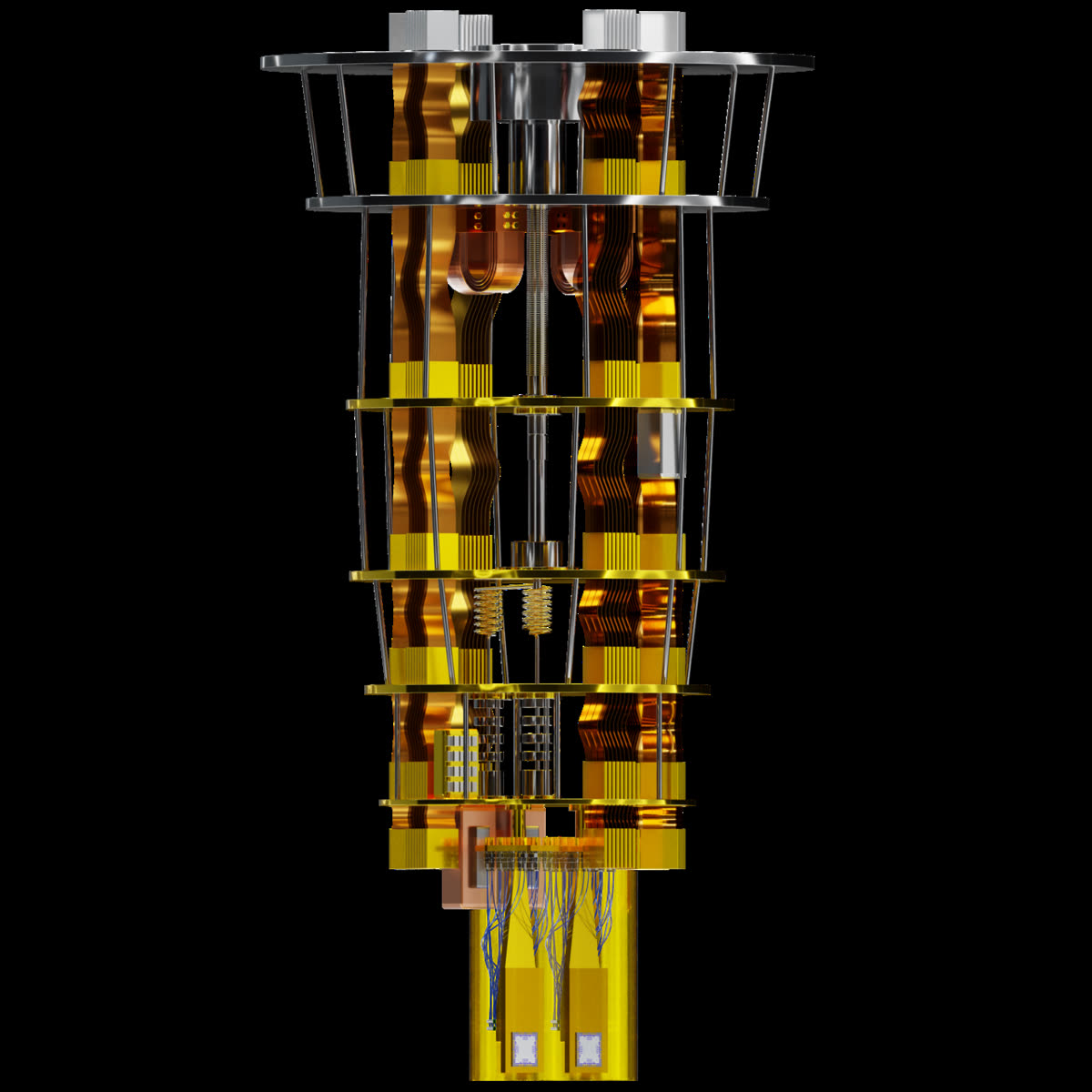
OJB Quantum, 2025-10-11. CC BY 4.0
Start on the equator and let time run. Watch the vector leave the surface.
Watch the coherence readout as time passes. Note that purity falls and then recovers towards 1 — because the qubit ends in the pure ground state, having lost the superposition entirely. Purity returning to 1 is not the qubit recovering. Coherence is the number that tells the truth here.
Watching a superposition decohere in real time
- The question
- Decoherence is invoked to explain why superpositions vanish. Can the process itself be observed as it happens — and does the decay rate depend on the "size" of the superposition, as theory requires?
- The apparatus
- A microwave cavity made of superconducting niobium mirrors, so good that a photon survives inside it for a substantial fraction of a millisecond. Rubidium atoms in highly excited Rydberg states were passed through one at a time; the first atom placed the cavity field into a superposition of two states with different phases — a small "Schrödinger cat" of a few photons — and a second atom sent through after a controlled delay probed whether the coherence between them had survived.
If decoherence is a real dynamical process rather than a bookkeeping device, the coherence should decay measurably, and faster for superpositions of more distinguishable states — the decoherence time should fall as the separation between the two components grows.
The coherence decayed on a timescale much shorter than the cavity’s own photon lifetime, and the rate increased with the separation between the two field components, exactly as predicted. Decoherence was observed as a continuous process with a measurable rate.
How sure could they be? Sufficient to trace the decay curve and confirm the scaling with the size of the superposition, which is the theoretically distinctive prediction. Haroche shared the 2012 Nobel Prize with David Wineland for this line of work.
It turns decoherence from an explanation into a measured phenomenon with a rate you can compute and check. That matters both ways: it supports the account of why the classical world looks classical, and it establishes the quantitative adversary that anyone building a quantum computer has to defeat. Note also what it does not do — it says nothing about why a single outcome occurs, which remains exactly where Act 6 left it.
Quantum computers have already achieved supremacy over classical computers, and are close to breaking encryption.
Neither, and it is worth being precise because this is where most of the exaggeration lives. Google’s 2019 Sycamore result demonstrated a sampling task that was chosen to be hard classically and natural for the hardware — it computes nothing anyone wanted computed, and improved classical algorithms subsequently narrowed the claimed gap by many orders of magnitude. As of now, no quantum computer has performed a useful calculation faster than a classical machine could. Not one. On encryption: Shor’s algorithm has factored numbers like 15 and 21, and factoring anything cryptographically relevant requires millions of physical qubits against the hundreds that exist. None of this casts doubt on the physics, which is not in question. It is a statement about engineering, and about the distance between a demonstration and a machine.
That said, the progress has been real, and on precisely the thing that matters. The threshold is the whole game. Below it, more qubits make things worse; above it, more make things better. Everything else is detail. In 2023 and 2024, several groups demonstrated logical qubits with lower error rates than their constituent physical qubits — Google's surface-code work showing error suppression that improves as the code grows, and neutral-atom and trapped-ion groups showing logical operations outperforming physical ones. That is the line between a laboratory curiosity and a technology, and it appears to have been crossed. What remains is scale, and scale is a matter of a great deal of engineering rather than of new physics. Which is a much better problem to have than the alternative.
- 1970Zeh proposes that environmental interaction, not measurement, destroys superposition.
- 1981–82Zurek develops decoherence quantitatively; "pointer states" explain which quantities look classical.
- 1996Haroche’s group watches a superposition decohere in real time.
- 1995Shor shows quantum error correction is possible; Steane independently.
- 1999First superconducting qubit: coherence 2 ns, enough for two operations.
- 2019Sycamore samples a contrived distribution; classical algorithms then close much of the gap.
- 2023–24Logical qubits outperform their physical constituents. The threshold is crossed.